
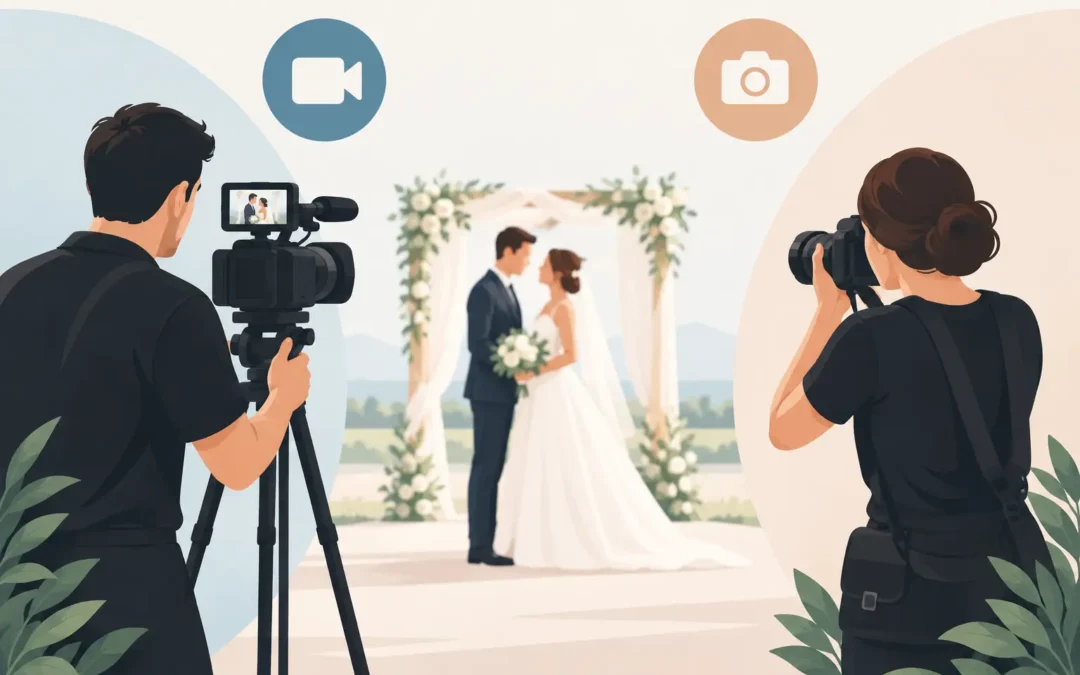
The videographer versus photographer question often comes up once the venue is booked and the guest list begins to feel real. Couples can usually picture beautiful photographs on the mantelpiece or in an album, but wonder whether film is an extra they will watch once and forget. The honest answer is that photography and videography preserve completely different parts of the day – and, together, they create a far richer record of it.
A wedding moves quickly. The nervous laugh before the ceremony, your dad’s voice during his speech, the roar when the dance floor kicks off, the way your dress moves as you walk through the grounds – these are moments that can be felt again through film. Photographs freeze the magic. Video lets it breathe.
Videographer versus photographer: what is the real difference?
A photographer tells your wedding story through individual, carefully observed images. One brilliant frame can hold an extraordinary amount: the look between you during the vows, the texture of your flowers, a tear on a grandparent’s cheek, or the full atmosphere of your ceremony space before guests arrive. Those images become the ones you print, frame, share and return to for decades.
A videographer works with movement, sound and pacing. Rather than choosing one still moment, they capture what happened immediately before and after it too. You do not simply see a loved one smiling during a speech; you hear the words that made them smile. You do not just see confetti in the air; you see it flying, hear the cheers and watch yourselves disappear into the middle of it all.
Neither is a replacement for the other. Photography gives you iconic keepsakes and detail you can take in slowly. Videography preserves the energy, voices and unfolding story that still images cannot hold. For a stylish South West wedding, from a country house near Bath to a coastal celebration in Devon, both can reflect the setting beautifully, but in distinct ways.
What wedding photography captures best
Photography is wonderfully immediate. A favourite image can live on your phone, be sent to family the next morning, printed into a thank-you card or placed in an album that gets passed around at Christmas. It is also especially powerful for the details you have spent months choosing: your stationery, tablescape, fashion, florals, cake and the quiet visual character of your venue.
Great photographers are masters of anticipation. They notice hands reaching for each other, a hug forming across the room, a friend laughing before anyone else has heard the punchline. They shape light, composition and timing into images that feel effortless, even when the day is moving at full speed.
For group photographs, photography is generally the most efficient format too. A good photographer can guide the moment with warmth, keep it brisk, and make sure you have the important combinations without turning your drinks reception into a lengthy queue. The results give you a clear visual record of the people who celebrated with you.
What wedding videography adds
Film brings back the parts of a wedding that are impossible to recreate later. Your voices will change over time. Children grow. Loved ones age. The words in your vows and speeches may become even more meaningful years after the day itself. Hearing them again can be incredibly moving.
A cinematic wedding film is not about filming every second without purpose. It is about taking the strongest moments, the natural interactions and the atmosphere around them, then editing them into a story with emotional rhythm. A highlights film can carry you from excited preparations to a packed dance floor in a few minutes, while full ceremony and speeches films keep the complete moments safe.
Movement changes the feeling of visual details too. A veil caught in a breeze, guests arriving across the lawn, confetti falling, a spin on the dance floor, the changing light during golden hour – these small pieces bring a sense of place and energy. Drone coverage, where appropriate and permitted, can also show the scale of a spectacular venue or landscape in a way that feels elegant rather than showy.
The most meaningful footage is rarely the most staged. A relaxed documentary approach means there is space for real nerves, private glances, proper laughter and all the good fun that happens when nobody is being asked to perform. You should feel present at your own wedding, not as though you are spending it on a film set.
Do you need both for your wedding day?
It depends on what you want to remember and how you want to revisit it. If you are choosing only one supplier, photography is often the more familiar starting point because images are easy to display, share and use straight away. If your budget allows, though, having both is one of those decisions many couples feel especially grateful for afterwards.
The strongest argument for film is not that it is better than photography. It is that it saves what photography cannot: voices, music, movement and the changing atmosphere of a day. Couples often say they were too busy living the celebration to notice every reaction or hear every comment. Their film gives them a chance to experience those moments properly, including parts of the day they were not there to see.
Think about the people you most want to remember. Perhaps it is a parent helping you get ready, a sibling reading during the ceremony, or friends giving a speech that has the whole room in tears. If hearing those voices again matters to you, video is not simply an add-on. It is part of the memory itself.
How photographers and videographers work together
There is no reason that having both should make your wedding feel busier. Experienced professionals are used to working alongside each other and will communicate throughout the day, especially around the ceremony, couple portraits, confetti and speeches.
The key is choosing people whose approach feels compatible. If you want natural, unforced coverage, look for a photographer and videographer who can blend into the celebration, offer gentle direction when it helps, and know when to step back. A few beautifully guided portrait moments can sit comfortably alongside candid documentary coverage.
During couple portraits, the best teams share the time rather than competing for it. The photographer may set up a still frame while the videographer captures movement around it. Sometimes a short walk, a hand held, or a simple conversation between the two of you creates material for both without adding anything artificial to the schedule.
It also helps to tell each supplier what matters most before the wedding. Mention family dynamics, meaningful readings, surprise entertainment, cultural traditions and any guests you particularly hope to capture. A thoughtful team can plan around those priorities while staying flexible enough for the lovely unscripted moments.
Questions to ask before booking
Rather than comparing packages on hours alone, ask what the finished experience will be. For a photographer, that may mean asking about the number of edited images, delivery times, albums and their approach to group shots. For a filmmaker, ask whether ceremony and speeches are filmed in full, whether professional audio is recorded, how many cameras are used, and what films are included.
Watch complete examples where you can, not only short social clips. A teaser can be exciting, but the longer highlights film reveals how a filmmaker handles storytelling, speeches and pacing. Listen for clear audio and look for a style that still feels genuine when the emotion is quieter.
You should also consider personality. Your visual suppliers will be close by during some of the most emotional, high-energy parts of the day. Choose people who make you feel at ease. The right presence is calm, capable and good fun – never intrusive, never adding pressure.
Choosing coverage that feels like you
If you love timeless still imagery, want an album full of your favourite faces and care deeply about the visual details, photography deserves a central place in your plans. If you light up at the thought of hearing your vows, reliving the speeches and watching your people in motion, film deserves one too.
For many couples, the answer is not videographer versus photographer at all. It is choosing a creative team that protects the feeling of the day while preserving it with care. Years from now, your photographs may stop you in your tracks. Your wedding film may make the room around you disappear for a few beautiful minutes – and bring you both right back to where it began.