
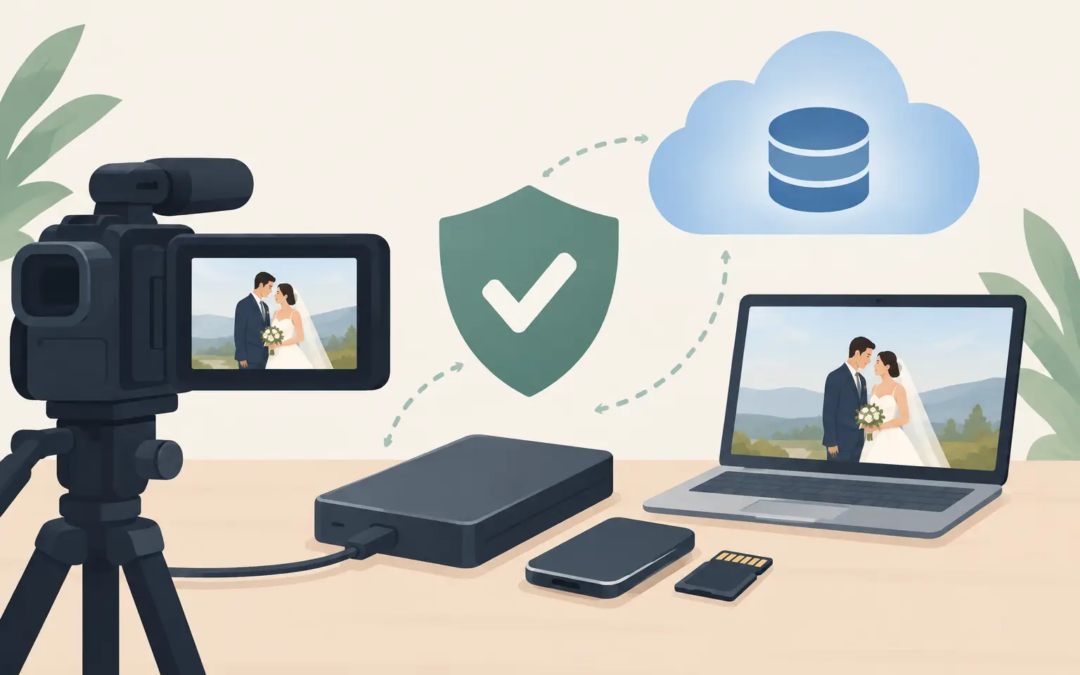
Your wedding happens once. The squeeze of a hand before the ceremony, the crack in a parent’s voice during a speech, the cheers as you step onto the dance floor – none of it can be recreated in quite the same way. That is why wedding video backups matter just as much as beautiful cameras, cinematic framing and an edit that gives you goosebumps.
Most couples understandably focus on the finished film. You want to know whether it will feel natural, look timeless and bring back the atmosphere of the day. But behind every relaxed, elegant wedding film should be a careful process for protecting the footage from the moment it is captured to the moment your final films are delivered.
Why wedding video backups are part of great service
A wedding filmmaker is trusted with moments that are completely unrepeatable. There is no second take for your vows. Your grandparents cannot deliver the same spontaneous toast again, and the confetti exit only happens once. A professional approach means thinking beyond what looks good on screen and taking the quiet, practical steps that keep those memories safe.
Backups are not the glamorous part of wedding videography, but they are a major part of the reassurance. They help protect footage against accidental card issues, lost drives, computer faults and the occasional real-life mishap that nobody plans for. While no technology can make every risk disappear entirely, a well-managed backup workflow greatly reduces the chance that one problem becomes a disaster.
For couples planning a wedding in Somerset, Bath, Bristol or further across the South West, this is worth asking about when you are comparing videographers. A lovely showreel tells you about their creative eye. Their process tells you how seriously they take the privilege of filming your day.
What a thoughtful backup process looks like
The best systems are built in layers. Rather than relying on one memory card, one hard drive or one computer, a filmmaker creates several points of protection throughout the journey of your footage.
During the wedding day
Many professional cameras record to two memory cards at the same time. This means the footage is saved twice as it is filmed, creating an immediate duplicate while the day unfolds. It is particularly reassuring for irreplaceable parts of the day, such as the ceremony, readings, speeches and first dance.
Not every camera setup records in exactly the same way, and a filmmaker may use different cameras for different angles or creative shots. Drone footage, for example, is often recorded differently from the main cameras. What matters is that there is a sensible plan for each part of the coverage, especially the moments that cannot be repeated.
Audio deserves the same care. The sound of your vows and speeches is a huge part of how your film feels years later. A professional filmmaker will often capture sound using more than one source, such as microphones on key people alongside an additional recorder connected to the venue’s sound system. This is not about making the day feel overly technical. It is about quietly allowing room for a backup if one source is affected by interference, a clothing rustle or an unexpected technical issue.
After the last song
Once the wedding is over, the cards should not simply be formatted and used again. The footage needs to be copied promptly to secure storage, ideally in more than one location or on more than one separate drive.
A common professional approach is to keep the original camera cards untouched until the footage has been transferred, checked and backed up. That gives the filmmaker an extra layer of protection while the copies are being made. It may sound cautious, but cautious is exactly what you want when your ceremony and speeches are involved.
The next stage is verification. Copying files is one thing; checking that they have transferred correctly and can be opened is another. A careful filmmaker will review the material, organise it properly and make sure the media is ready for the edit before relying on the new copies alone.
While your film is being edited
Editing a cinematic wedding film can take time, care and a surprising amount of storage. There may be footage from multiple cameras, separate audio recordings, drone clips and music elements, all carefully shaped into a story that feels like your day rather than a highlights reel of random moments.
During this period, footage should remain protected on working storage and a separate backup. Keeping a further copy away from the main editing setup adds another useful level of security. If a computer or drive fails, the project is not dependent on one device.
This is also why turnaround times should not be rushed for the sake of it. A considered edit needs space for storytelling, colour grading, sound design and quality checks. Behind the scenes, it also needs a process that treats every file with the respect it deserves.
Questions to ask about wedding video backups
You do not need to become an expert in memory cards or hard drives before booking your videographer. A good filmmaker should be happy to explain their approach in plain English and make you feel comfortable asking.
When chatting with potential suppliers, ask whether they use dual-card recording where possible, how they back up footage after the wedding, how long they keep original files and whether they use more than one audio recording method for the ceremony and speeches. You can also ask what happens if a camera, card or audio device has an issue on the day.
There is no need to expect a dramatic, jargon-heavy answer. In fact, a clear and calm explanation is often the best sign. You are looking for someone with a repeatable system, not someone promising that technology can never fail.
How long should footage be kept?
This varies between filmmakers, so it is always worth checking before you book. Some retain the raw footage and project files for a set period after delivery, while others may offer longer-term archival storage as an additional service.
It is helpful to understand the difference between your finished films and the original footage. Your highlights film, teaser, full ceremony and speeches films are polished final products. Raw footage is the unedited material recorded throughout the day, and it can take up a considerable amount of storage space.
If having access to raw footage matters to you, raise it early. Some couples love the idea of keeping every clip, while others are happiest with beautifully edited films that let them relive the best of the day without hours of unfiltered material. Neither choice is wrong. It depends on what you value and what has been agreed in your package.
Once your final wedding films are delivered, download them promptly and save them somewhere safe yourself. Keep more than one copy if you can – for example, on a personal hard drive and a trusted cloud storage service. Your filmmaker may retain material for a period, but your own copies mean your favourite memories stay close at hand for the decades ahead.
Backup planning should never spoil the vibes
All this careful preparation happens largely out of sight. On the wedding day, you should not feel as though you are starring in a technical production. The goal is still a relaxed, documentary experience: genuine hugs, brilliant speeches, chaotic dance-floor moments and all the little glances you may miss while living them.
A capable wedding filmmaker balances preparation with presence. They arrive organised, work smoothly alongside your photographer and venue team, and keep the energy positive. The careful backup process is there so they can focus fully on capturing the emotion, movement and good fun as it naturally happens.
Your wedding film is an investment in the future version of you. Choose a filmmaker whose work makes you feel something, then give yourself the extra peace of mind of knowing that the laughter, voices and atmosphere behind those beautiful frames are being looked after too.